Outdoor Programming with iNaturalist
Encourage patrons to discover nature, contribute to community science, and explore the biodiversity of Montana through both guided and self-guided activities.
What is iNaturalist?
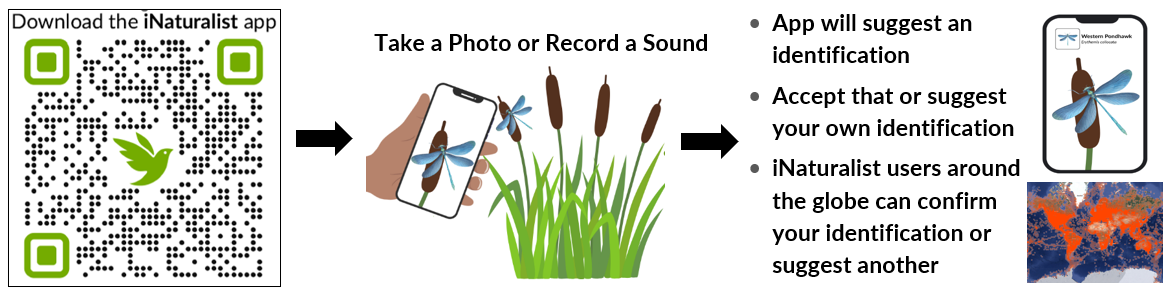
iNaturalist Discovery
Invite your patrons to explore local ecosystems and log observations.
Examples:
Citizen Science
The programs below will offer different variations on the citizen science theme in Montana at the micro and macro level. Some will feature the state as a whole, others will be so specific you can narrow it down to what is observable right outside your library. Some of these projects will encourage your library to create an iNaturalist project limited to your local footprint, or area while others will rely on the Montana iNaturalist Place Page.
Resources
Outdoor programming ideas:
Age: Adults
Effort: Low to High depending on your choice of variations
Effort: Low to High depending on your choice of variations
A relaxed and community‑friendly program that pairs an indoor mini lecture with an outdoor guided biodiversity walk. Participants learn about local conservation issues and use iNaturalist to document real species observations that contribute to community science.

Age: Scalable.
Effort: Low to high depending on your choice of variations
Effort: Low to high depending on your choice of variations
A kid-friendly scavenger hunt encouraging explorers to find trees, insects, tracks, clouds, birds, rocks, flowers, and more while exploring Montana’s outdoors.
Age: Scalable
Effort: Low to High depending on your choice of variations
Effort: Low to High depending on your choice of variations
This program engages people of any age and their caregivers as they explore a local park or outdoor area. Children receive physical checklists and search for simple observable natural items. The Seek app provides quick and kid-safe identification without accounts or data collection.

Age: 13+ or younger with help from an adult
Effort: Medium to high depending on your choice of variations
Effort: Medium to high depending on your choice of variations
Age: Scalable
Effort: Medium to high depending on your choice of variations
Effort: Medium to high depending on your choice of variations
This program is a QR‑Code enhanced nature walk that transforms the outdoor area around the library into an interactive field guide powered by iNaturalist. Each stop along the walking route links to species profiles, identification tools, and quick iNaturalist tips.

Age: Scalable - ideal for 8 and up
Effort: Medium
Effort: Medium
Pixel Art to Real Life encourages participants to explore patterns, colors, and textures in nature through macro photography and iNaturalist. After photographing natural features outdoors and identifying them online, participants translate their observations into pixel‑style artwork using grid paper and colored pencils.
Age: 3-6
Effort: Medium
Effort: Medium
The program begins indoors with a nature-themed picture book and continues outdoors with a guided photo safari where children use tablets to photograph plants, insects, textures, and shapes. Participants learn how simple technology can support scientific discovery while connecting the outdoor experience to the story shared at the beginning of the session.

Age: Scalable
Effort: Low to Medium depending on your choice of variations
Effort: Low to Medium depending on your choice of variations
The Unseen World Challenge invites participants to explore subtle and easily overlooked signs of life such as lichen, spider webs, fungi, and small hidden habitats found in everyday surroundings. Participants photograph their discoveries and use iNaturalist or Seek to reveal the biodiversity supported by even the smallest urban spaces.

Back to the Nature Discovery trunk